Why should ‘al-Fatāwā al-Riḍawiyya’ be translated into Arabic?

Since the Sharīʿa of Islam is designed to be valid for every time and place, scholars have long assumed the task of responding to people’s inquiries about their daily lives—including matters of worship, transactions, interpersonal relations, and all other issues arising. Whether microscopic or macroscopic, the Sharīʿa can deal with issues concerning individuals, institutions, and states. The continuous development of Fiqh stands as evidence of this responsiveness, clarifying the rulings of Allah, the Exalted, in all matters relevant to the Muslim.
After the establishment and consolidation of the Madhāhib (or schools of thought), and once people came to rely upon their doctrines and trust the precision of their juristic inferences, departing from these schools came to be regarded as a mark of deviation and a cause of doctrinal destabilisation. For this reason, even the greatest jurists who later attained the rank of absolute ijtihād remained under the umbrella of these schools, taking pride in their affiliation to them and defending their legal methodologies.
For this reason, even the greatest jurists who later attained the rank of absolute ijtihād remained under the umbrella of these schools, taking pride in their affiliation to them and defending their legal methodologies.
Following this period of stability, the jurists of the Umma continued to address emerging cases, novel circumstances, and contemporary legal questions—each according to the principles of his own respective madhhab.
Genres of Fiqh works
Anyone who surveys the scholarly tradition of Islam will find that works of Fiqh fall into several categories:
- First, there are comprehensive legal works covering all chapters of Fiqh, ranging from concise manuals to extensive treatises, some focused on evidences, others on legal reasoning, comparison, or the science of juristic disagreement. These works contain numerous cases and legal questions encountered by their authors, who addressed them under the appropriate legal principles.
- Second, there are monographs dedicated to a single issue, often one that had newly arisen in the author’s time or had become widespread and pressing, prompting the scholar to examine it closely and articulate its governing legal ruling.
- Third, there are collections of responses to inquiries and fatāwā directed to jurists. These consist of gathered questions alongside their answers, either compiled by the jurist himself or arranged by one of his students or by members of his scholarly circle. These works often present succinct responses suited to the needs of the questioner. The questions in such compilations fall into two types: those for which the jurist finds an explicit answer in the authoritative texts of the madhhab, and those for which no direct answer exists, requiring him instead to derive a ruling through the legal principles and foundational texts of the school. These fatāwā are characterised by their adherence to the methodological principles of the madhhab and by their careful engagement with the jurists’ authoritative statements. They also take into consideration situational factors essential to issuing fatwas, such as necessity, prevailing custom, alleviation of hardship, and the overarching objectives of the Sharīʿa in promoting benefit and preventing harm.
A careful reading of these compilations reveals a rich body of social, psychological, and cultural insights into the era in which the fatāwā were issued, as well as a noticeable variance between the responses of jurists of the same period. This variance prompted later scholars to review, compare, and refine these opinions, and indeed, some undertook the task of compiling the fatwas of the scholars of an entire school into dedicated volumes.
The questions in such compilations fall into two types: those for which the jurist finds an explicit answer in the authoritative texts of the madhhab, and those for which no direct answer exists, requiring him instead to derive a ruling through the legal principles and foundational texts of the school.

significant Ḥanafī fatwā works
Among the most significant Ḥanafī works of fatwā are:
- ‘Al-Nawāzil’ by Abū al-Layth al-Samarqandī (D. 373 AH), described by Ibn ʿĀbidīn as “the first book compiled in the fatāwā of our [Ḥanafī] scholars, as far as is known.”
- ’Al-Wāqiʿāt’ by al-Nāṭifī (D. 446 AH).
- ’Wāqiʿāt al-Ḥisāmī’ by al-Ṣadr al-Shahīd (D. 536 AH), which combines al-Samarqandī’s ‘Nawāzil’ and al-Nāṭifī’s ‘Wāqiʿāt’, and also draws from the fatāwā of Abū Bakr Muḥammad b. al-Faḍl and al-Samarqandī, with coded references indicating each source.
Such works multiplied greatly in later centuries, including fatāwā by Qāsim b. Quṭlubughā, Ibn Nujaym, and al-Timurtāshī, among many others produced in the Ottoman era—an extensive corpus worthy of study from multiple angles.

the Ḥanafī School in the Indian subcontinent
During the period from the Tenth to the Fourteenth Century AH, there was remarkable activity in the service of the Ḥanafī School in the Indian subcontinent. Their juristic output which, when evaluated against the principles and core texts of the madhhab, reflects a distinguished scholarly production both in quantity and quality. They played a major role in advancing Ḥanafī jurisprudence through authorship, teaching, legal reasoning, rigorous analysis, and engagement with emerging legal questions.
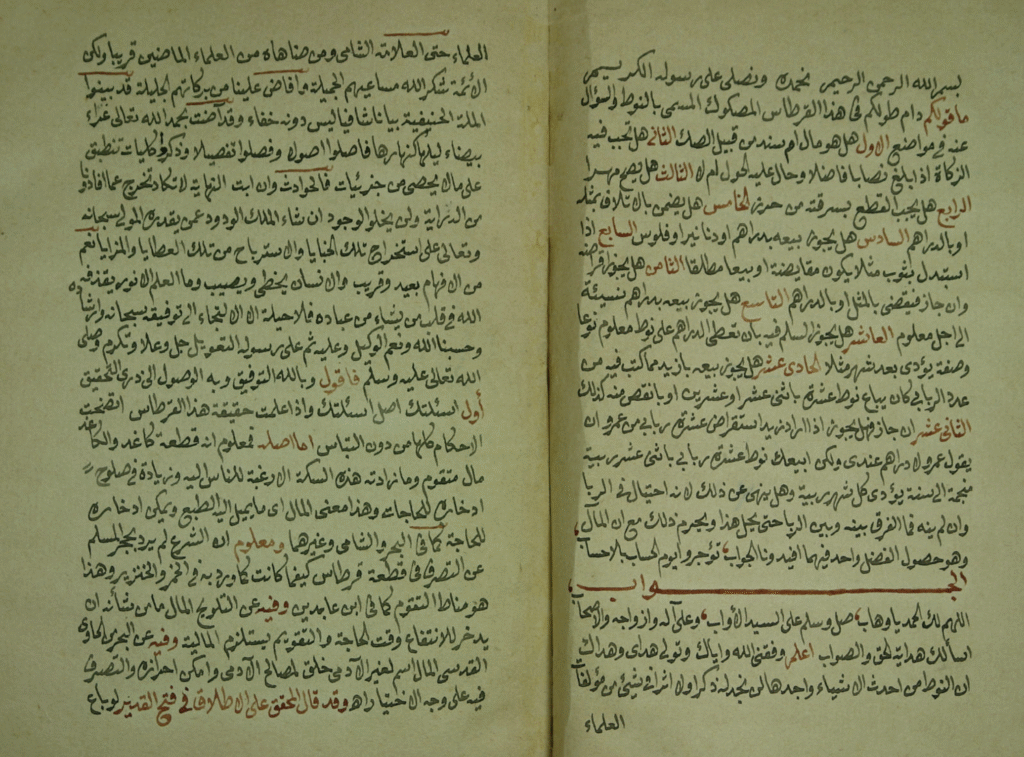
Among their most significant contributions is the extensive encyclopaedic work ‘al-ʿAṭāyā al-Nabawiyya fī al-Fatāwā al-Riḍawiyya’, authored by one of the foremost scholars of India, Imām Aḥmad Riḍā Khān (D. 1340 AH). This monumental project comprises nearly seven thousand fatāwā and more than four hundred treatises. It has long drawn the attention of Ḥanafī scholars who have attempted in various ways to serve, edit, and disseminate it. Yet, a comprehensive scholarly edition and an elegant, fully realised presentation remain an aspiration.
For this reason, Dar al-Imam Yusuf al-Nabhani has undertaken a serious scholarly initiative to produce a complete Arabic edition of this encyclopaedia, issuing it in sequential phases and grouped volumes. The aim is to approach the highest degree of accuracy and refinement in its verification, scholarly treatment, and aesthetic presentation.
May Allah grant it success.